Ulfert Wilke was born in Bad Tölz, Germany, in 1907. He studied in Europe before emigrating to the United States, where he built a career as both a practising artist and a respected museum director — serving at the Louisville Art Center, the University of Iowa Museum of Art, and the Honolulu Academy of Arts. That combination of deep institutional knowledge and sustained creative practice gave him an unusually broad perspective on the art of his time, and he moved comfortably between the roles of artist, curator, collector, and advocate throughout his life.
Wilke’s art was shaped by two powerful and complementary influences — the gestural abstraction of the New York School, among whose leading figures he counted close friends, and the calligraphic traditions of East Asia, which he studied with genuine scholarly seriousness. He collected Asian art extensively and travelled repeatedly to Japan, where he engaged directly with masters of ink calligraphy. The result was a body of work that occupies a singular position — neither purely Western abstraction nor Eastern calligraphy, but a genuine synthesis of both, in which the single expressive mark becomes the fundamental unit of meaning.
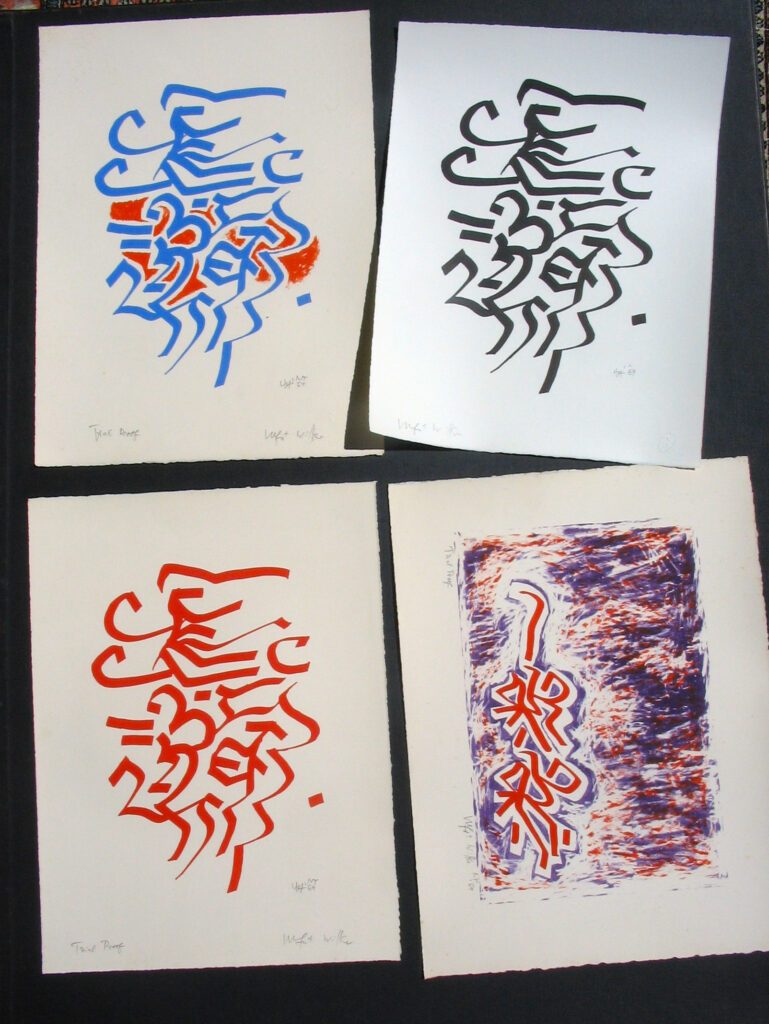
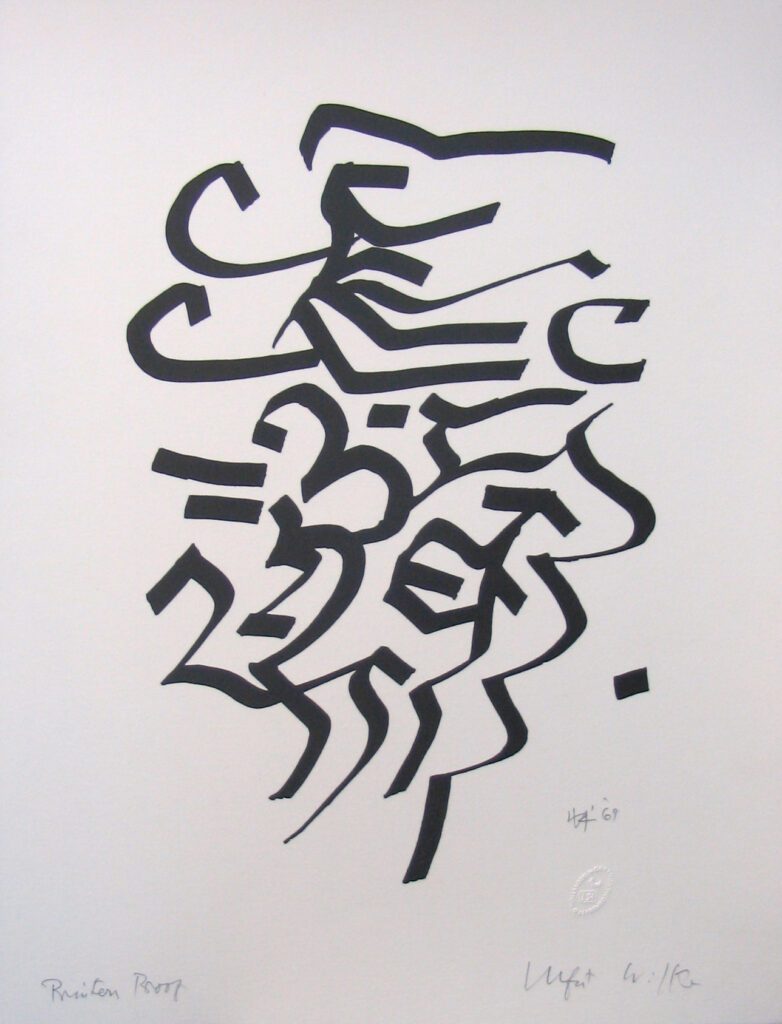
His print Calligraphy, produced at Hollanders Workshop, New York, in collaboration with Fred Genis and Irwin Hollander, is a natural expression of his deepest artistic preoccupations. Lithography — with its capacity to capture the most nuanced qualities of a drawn or brushed mark, preserving the weight, speed, and intention of the original gesture — was ideally suited to work of this kind. The print carries the same meditative intensity as his paintings, each mark placed with the precision and deliberateness of a calligrapher who understands that how a line is made is inseparable from what it means.
Ulfert Wilke died in Honolulu, Hawaii, in 1987.