Lee Bontecou was born in Providence, Rhode Island, in 1931. She studied at the Art Students League in New York before receiving a Fulbright scholarship to Rome, where she spent two formative years developing the sculptural vocabulary that would make her one of the most distinctive and unsettling presences in postwar American art. Returning to New York in the late 1950s she found her place among a generation of artists redefining what sculpture could be — and promptly took that conversation somewhere entirely her own.
Bontecou is best known for her large wall-mounted relief sculptures of the 1960s — powerful, brooding constructions of welded steel and salvaged canvas that open onto dark, seemingly bottomless voids. These works are simultaneously mechanical and organic, suggesting jet engines, mouths, flowers, and wounds all at once. They carry a visceral psychological charge quite unlike anything else being made at the time, and their influence on subsequent generations of artists has been considerable. After withdrawing from the New York art world in the early 1970s to focus on teaching and her own independent practice, she was rediscovered by a new generation in the 1990s and her reputation has continued to grow ever since.
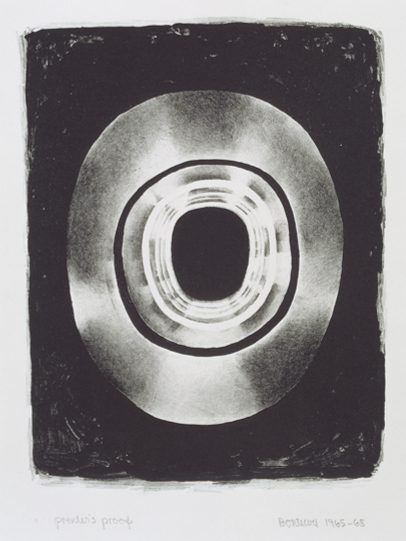
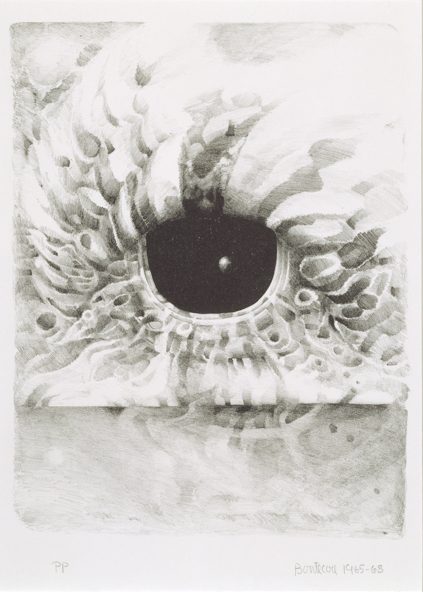
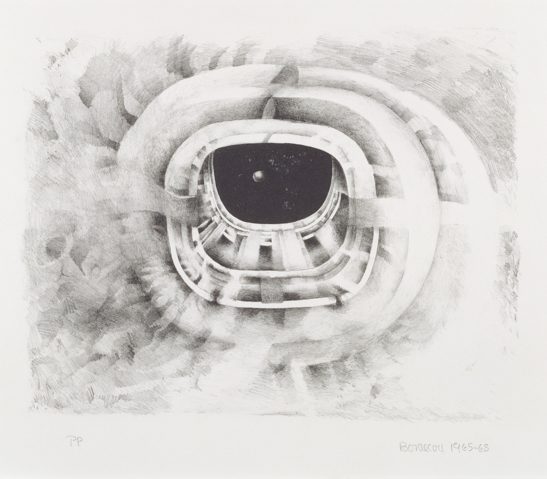
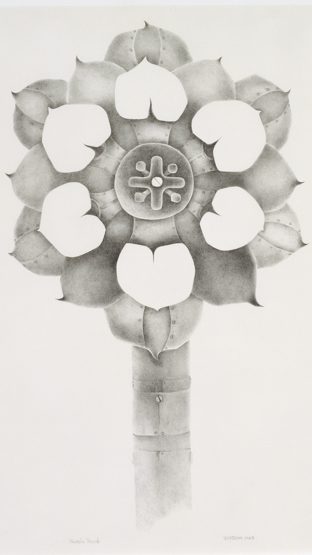
Her prints Seventh Stone, Eighth Stone, Ninth Stone, and Tenth Stone were produced at Universal Limited Art Editions, New York, in collaboration with Fred Genis and Tatyana Grosman. The sequential titling — each work named simply for its stone — speaks directly to the lithographic process itself, acknowledging the physical material of printmaking as integral to the work’s identity. The prints carry the same brooding, centrifugal energy as her sculptures, dark forms pulling the eye inward toward a space that feels simultaneously threatening and compelling.
Lee Bontecou continues to live and work in the United States. Her work is held in the Museum of Modern Art, the Whitney Museum, and major collections worldwide.