Josef Albers was born in Bottrop, Germany, in 1888. He studied and later taught at the Bauhaus — the legendary German school of art and design that fundamentally reshaped the visual culture of the twentieth century — before fleeing the rise of National Socialism and emigrating to the United States in 1933. He joined the faculty of Black Mountain College in North Carolina, where he taught for sixteen years, and later became chair of the Department of Design at Yale University. As both artist and educator, his influence on successive generations of American artists was immense and enduring.
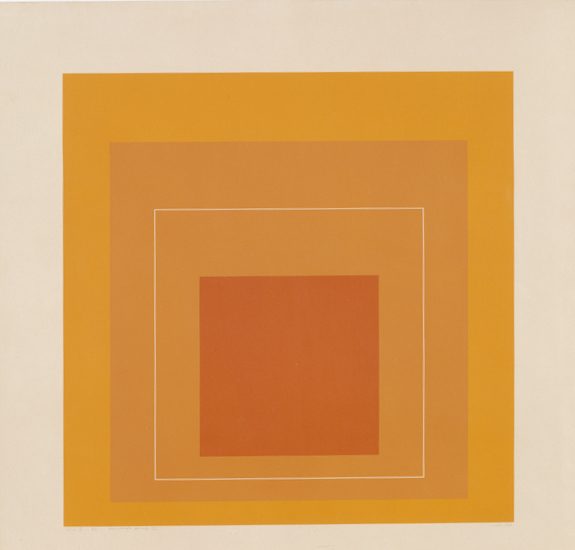
Albers is best known for his celebrated series Homage to the Square, begun in 1950 and continued for the rest of his life — a sustained, systematic investigation into the interaction of colour through the simplest of formats: nested squares of flat, unmodulated colour. The series, comprising hundreds of paintings and prints, demonstrates that colour is never absolute but always relative — that the same colour will appear entirely different depending on what surrounds it. It is one of the most rigorous and illuminating bodies of work in modern art, as much scientific inquiry as artistic practice.
His print White Line Square, produced in collaboration with Fred Genis at Tamarind Lithography Workshop in Los Angeles, is a precise and beautiful expression of his lifelong preoccupations. The introduction of a white line between the nested squares creates a luminous interval — a breath of space that alters the relationship between the colour fields in ways both subtle and dramatic. Lithography, with its capacity for the flattest, most even areas of pure colour, was ideally suited to the demands of his practice, and the Tamarind workshop’s exacting standards matched his own perfectly.
Josef Albers died in New Haven, Connecticut, in 1976. His work is held in virtually every major museum collection in the world.