Jean Michel Folon was born in Uccle, Belgium in 1934. He studied architecture before abandoning it for illustration and graphic art, moving to Paris in 1955 where he began a career that would make him one of the most recognisable and beloved visual artists in the French-speaking world. Tender, melancholic, and quietly surreal, his work found its way onto the covers of Time and The New Yorker, into animated films, tapestries, sculpture, and watercolour — a body of work that crossed every boundary between fine art and popular culture with complete ease and total conviction.
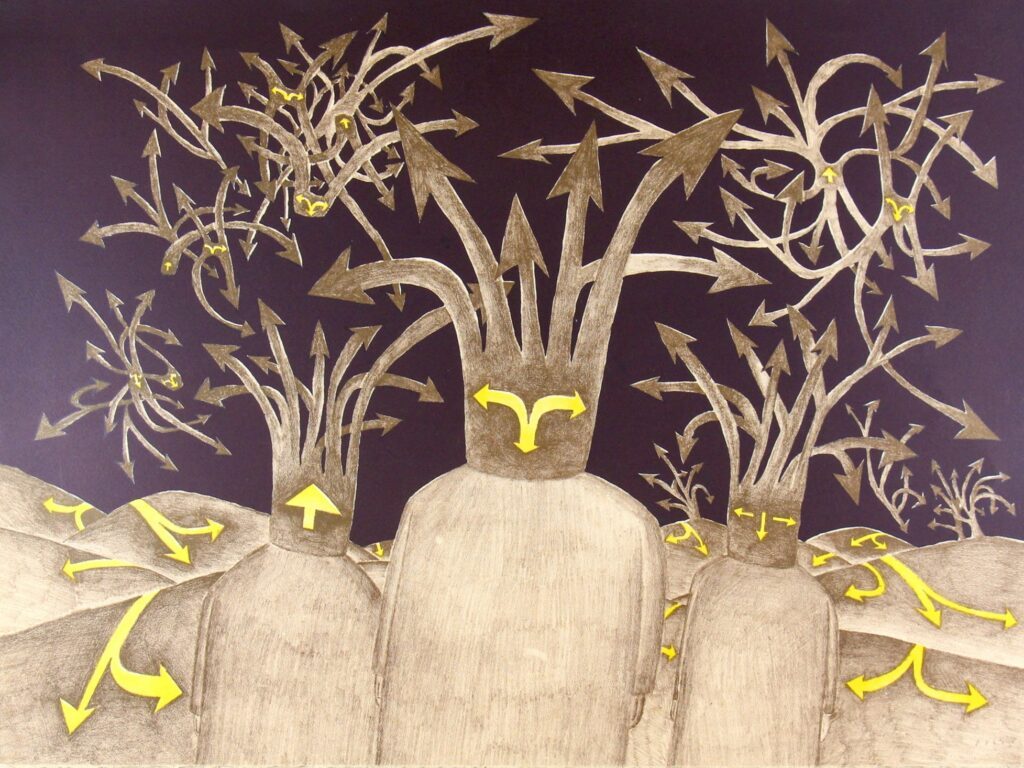
Folon’s imagery is immediately distinctive — solitary human figures dwarfed by vast spaces, birds in flight, arrows pointing nowhere and everywhere at once, dreamlike landscapes suffused with soft atmospheric colour. His world is one of gentle existential wonder, in which the small human being navigates a universe that is beautiful, bewildering, and faintly absurd. There is nothing aggressive or confrontational in his vision — only a deep, warm curiosity about what it means to be alive and uncertain.
His print Arrows Blues (1969), produced in three colour plates in an edition of seventy-five in collaboration with Fred Genis, is characteristic of his early graphic work — the arrow, one of his most recurring motifs, rendered in the soft atmospheric blues that became his signature palette. The arrow in Folon’s hands is never merely directional; it is a philosophical object, pointing simultaneously toward possibility and confusion, freedom and lostness.
Folon went on to establish the Folon Foundation at the Château de la Hulpe in Belgium, dedicated to the preservation and promotion of his work.
Jean Michel Folon died in Monaco in 2005.