June Wayne was born in Chicago, Illinois, in 1918. Self-taught as an artist, she began her career as a painter before discovering lithography in the late 1940s and recognising in it a medium of extraordinary expressive potential. What followed was a lifetime of creative and institutional commitment to printmaking that transformed the art form in America. In 1960, with a grant from the Ford Foundation, she founded the Tamarind Lithography Workshop in Los Angeles — an institution that single-handedly revived the craft of fine art lithography in the United States by training master printers and bringing major artists to the medium. Her contribution to American printmaking is without parallel.
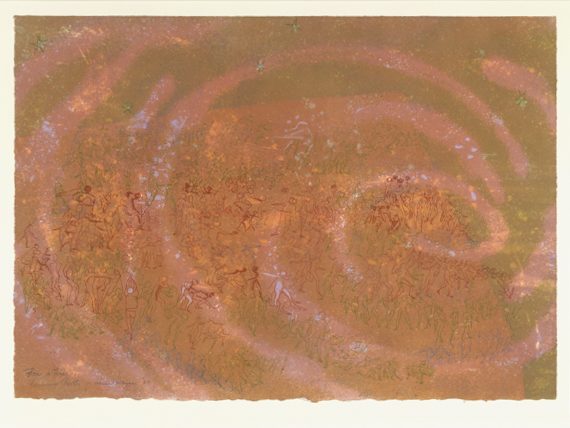
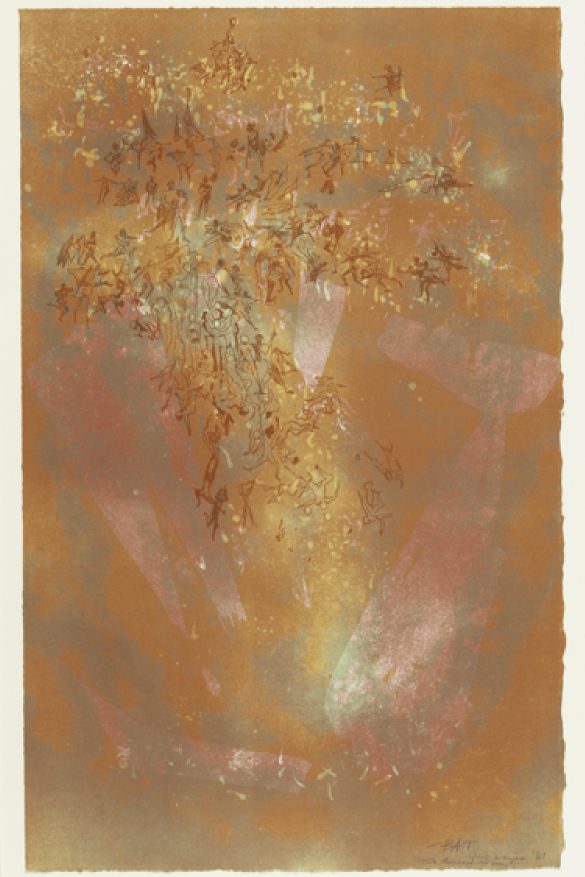
As an artist in her own right, Wayne produced a body of prints of remarkable ambition and intelligence. Her work ranged across cosmic imagery, cellular and astronomical forms, and pointed social commentary — she was never an artist content to make beautiful objects alone, but one who believed art had a responsibility to engage with the world. Her prints are visually arresting and conceptually serious in equal measure, combining scientific curiosity with a strong sense of moral purpose.
Her prints Lemmings, Crush, and Two Thousand Too Soon, produced in collaboration with Fred Genis, reflect this characteristic combination of visual power and social urgency. The titles alone signal her intent — collective self-destruction, pressure, and a world moving too fast toward an uncertain future. Lithography, the medium to which she had devoted so much of her professional life, becomes in these works a vehicle for ideas of genuine weight and consequence.
Wayne received numerous honours throughout her career including the National Medal of Arts, awarded in 2011 in recognition of her transformative contribution to American art.
June Wayne died in Los Angeles in 2011 at the age of ninety-three.