Gego was born Gertrud Goldschmidt in Hamburg, Germany, in 1912. She studied architecture and engineering at the Stuttgart Technical University before fleeing Nazi Germany in 1939 and emigrating to Venezuela, where she would spend the rest of her life and produce the body of work that has secured her place as one of the most original artists of the twentieth century. Though she worked at some remove from the major art centres of New York and Europe, her reputation has grown steadily since her death and she is now recognised internationally as a figure of immense importance.
Gego’s work defies easy categorisation. Beginning as a painter and printmaker, she moved progressively toward sculpture and installation, developing a practice centred on line, structure, and space. Her most celebrated works — the Reticuláreas, large-scale mesh installations made from irregular grids of wire and metal — fill entire rooms with trembling, interconnected networks that seem to dissolve the boundary between object and space, between drawing and three dimensions. They are works of extraordinary delicacy and rigour, built from the most elemental of gestures: the line extended into space.
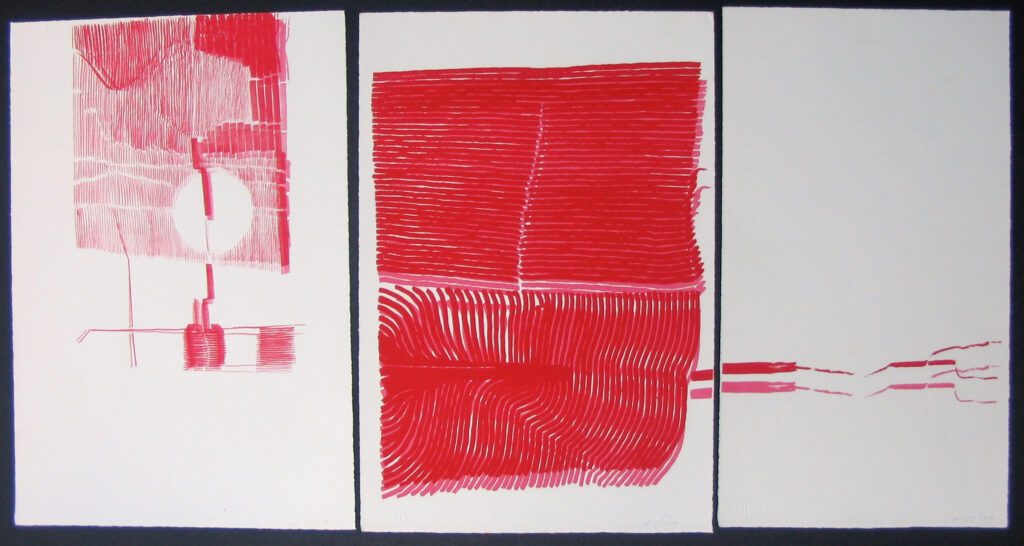
Her printmaking was equally precise and inventive, reflecting the same fascination with line, geometry, and the relationships between form and void that animated her sculpture. Prints and drawings were never peripheral to her practice but central to it — a space where ideas were tested, developed, and given their most distilled expression.
Gego died in Caracas, Venezuela, in 1994. Her work is held in the Museum of Modern Art in New York, the Museo de Bellas Artes in Caracas, and major collections across Latin America and Europe.