Lila Katzen was born in Brooklyn, New York, in 1932. She studied at the Art Students League in New York and later in Paris, before establishing herself as a sculptor and installation artist of considerable originality. Working primarily in metal — steel, aluminium, and bronze — she developed a practice centred on large-scale environmental sculpture that engaged directly with the spaces it inhabited, inviting the viewer into a physical and sensory relationship with form, light, and mass.
Katzen came to prominence in the late 1960s and early 1970s with her pioneering light and liquid environments — immersive installations that used ultraviolet light, fluorescent pigments, and reflective materials to transform gallery spaces into fields of luminous, shifting colour. These works placed her at the forefront of installation and environmental art at a moment when artists were radically rethinking the relationship between art, space, and the viewer’s body. She was one of relatively few women working at that scale and ambition in that period, and her contribution to the development of environmental and public sculpture deserves wider recognition than it has often received.
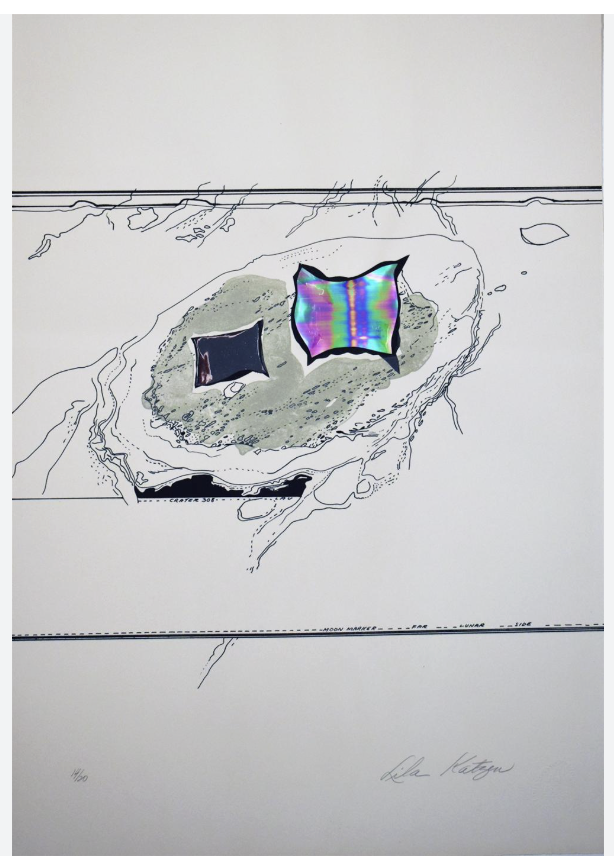
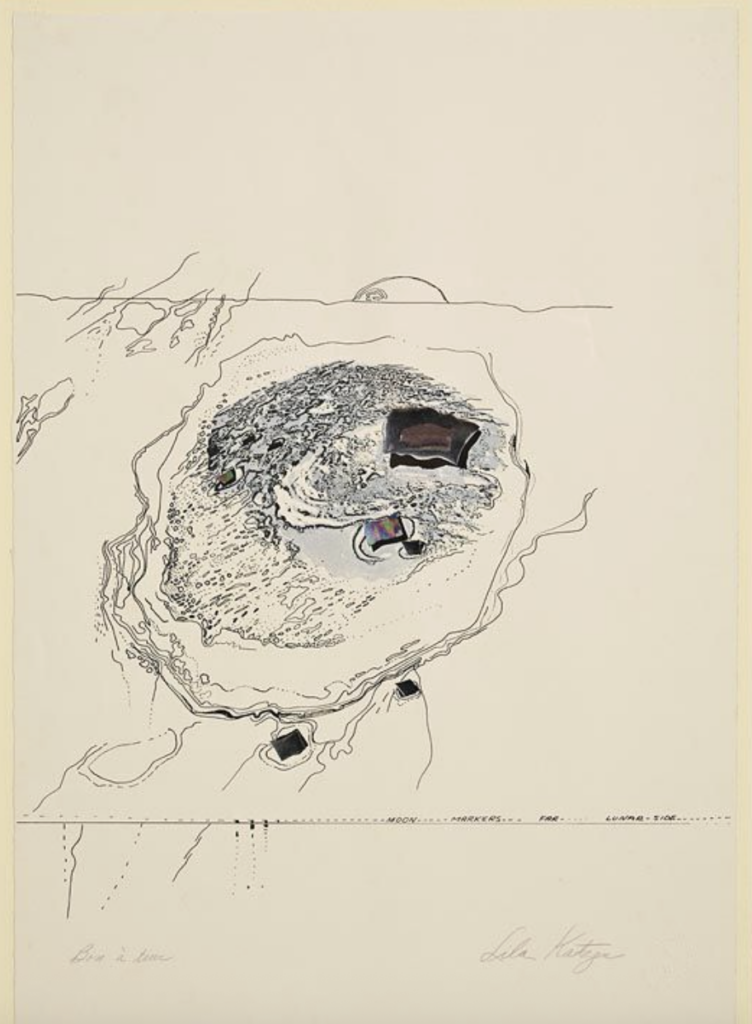
Her prints Moon Marker Far Lunar Side 1 and 2 were produced at Hollanders Workshop, New York, in collaboration with Fred Genis and Irwin Hollander. The works are among the most technically distinctive in the collection — each print combining delicate topographical line drawing of lunar crater formations with inlaid metallic elements that shimmer with iridescent colour against the otherwise spare composition. These embedded metallic pieces catch and shift the light in a way no purely printed surface could achieve, bringing Katzen’s characteristic preoccupation with reflectivity and luminosity directly into the print medium. The result is something genuinely rare — a lithograph that is simultaneously a drawing, a map, and a sculptural object.