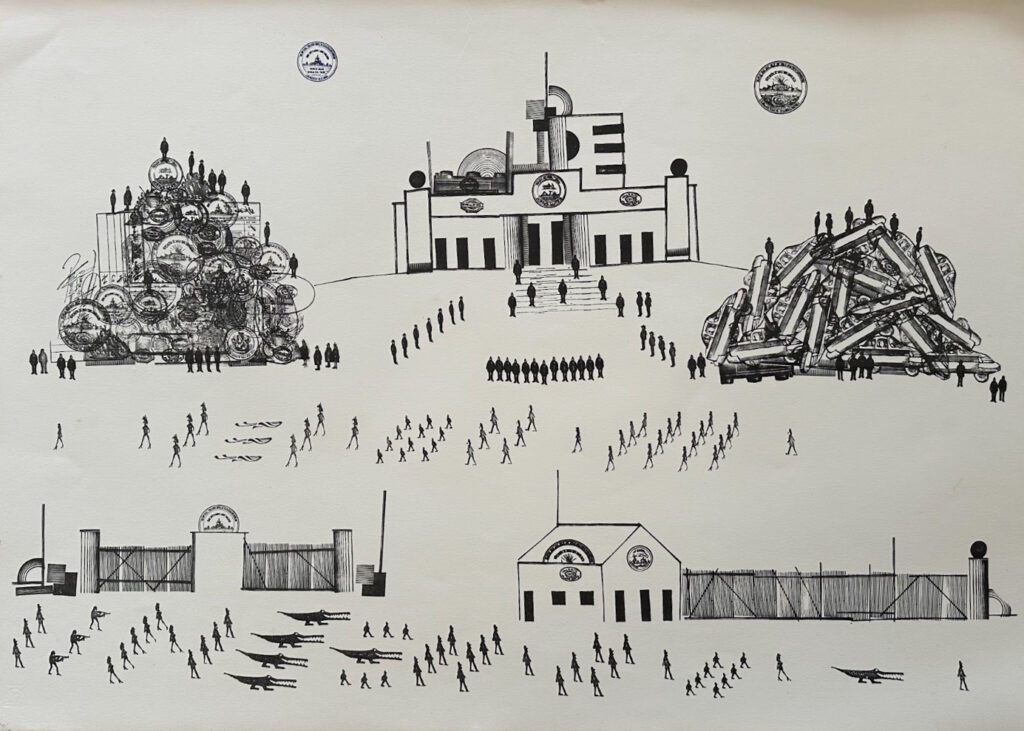
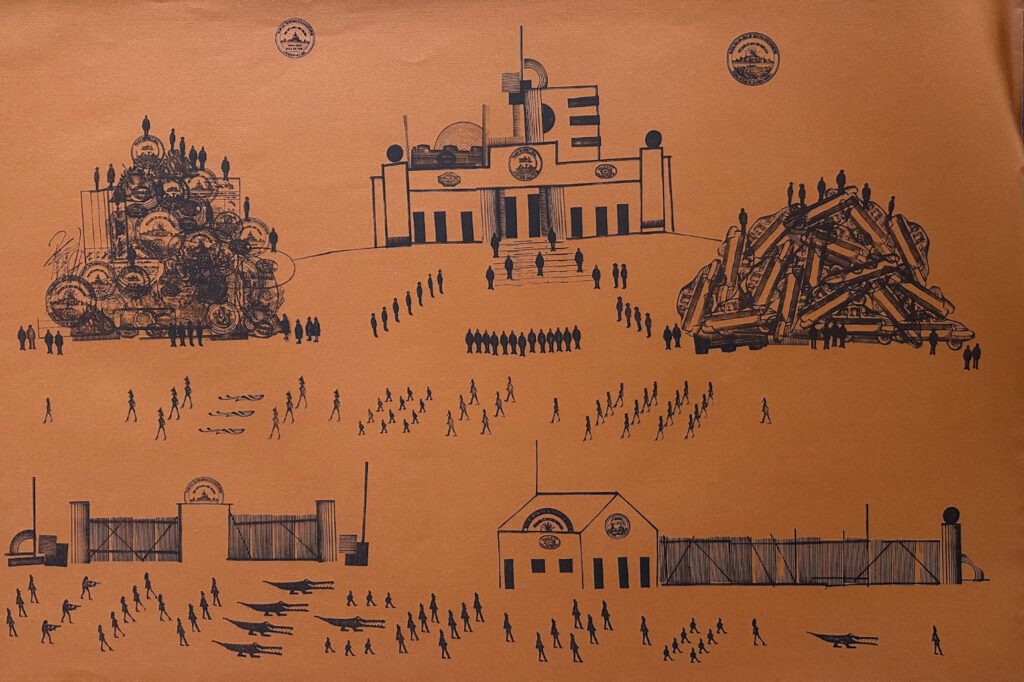
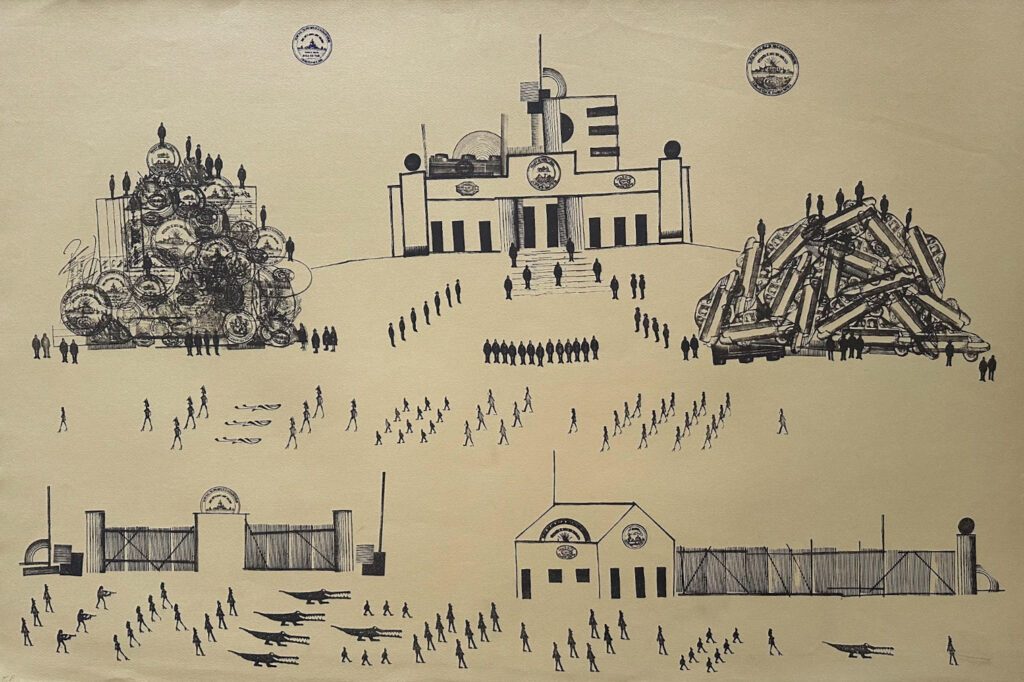
Saul Steinberg was born in Râmnicu Sărat, Romania, in 1914. He studied philosophy in Bucharest before moving to Milan to study architecture, a training that gave him the precise, analytical eye and the delight in structure that would define his entire artistic career. Fleeing fascist racial laws, he emigrated to the United States in 1942 and almost immediately began contributing to the New Yorker magazine — a relationship that would last over five decades and produce some of the most celebrated and intellectually playful graphic art of the twentieth century.
Steinberg occupied a singular position in American culture — neither quite a cartoonist, nor a painter, nor a draughtsman, but something entirely his own. His work plays ceaselessly with the nature of representation itself — with the line as both mark and meaning, with the conventions of drawing as a subject for drawing, with maps, signatures, rubber stamps, and official documents as materials for wit and philosophical inquiry. His famous 1976 New Yorker cover depicting the world as seen from Ninth Avenue remains one of the most recognised images in American visual culture.
His lithographs, printed by Irwin Hollander at Hollanders Workshop in New York, exist as a small and rare chapter in his printmaking history. Produced in an edition of ten, the prints were not signed by Steinberg himself — an unusual circumstance that long gave pause to collectors and institutions. However their authenticity has since been confirmed by the Saul Steinberg Foundation, which has verified them as genuine Steinberg lithographs. This confirmation was supported by Jim Sheehy assistant at the Hollanders Workshop, who provided firsthand account of their production.
Saul Steinberg died in New York in 1999. His work is held in the Museum of Modern Art and major collections worldwide.