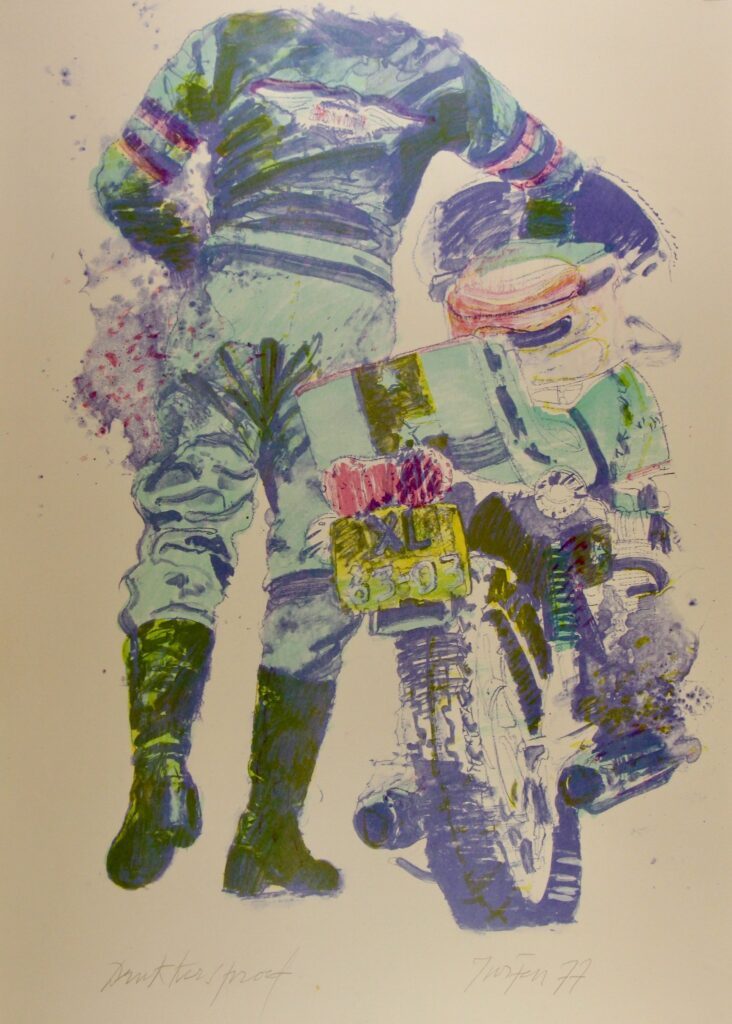
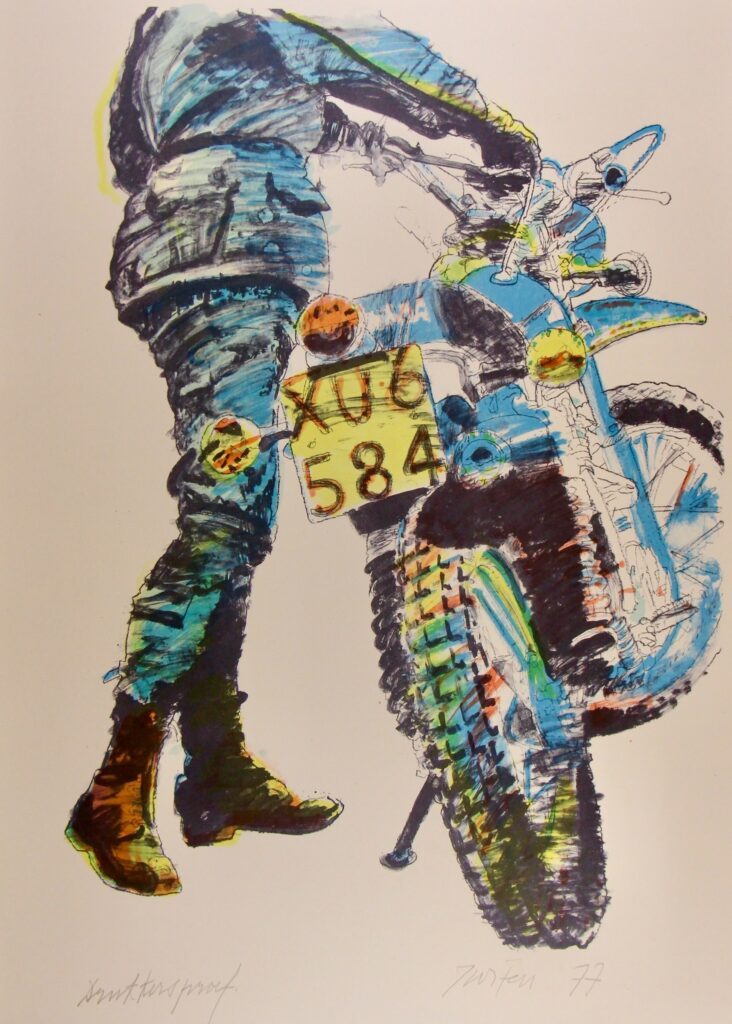
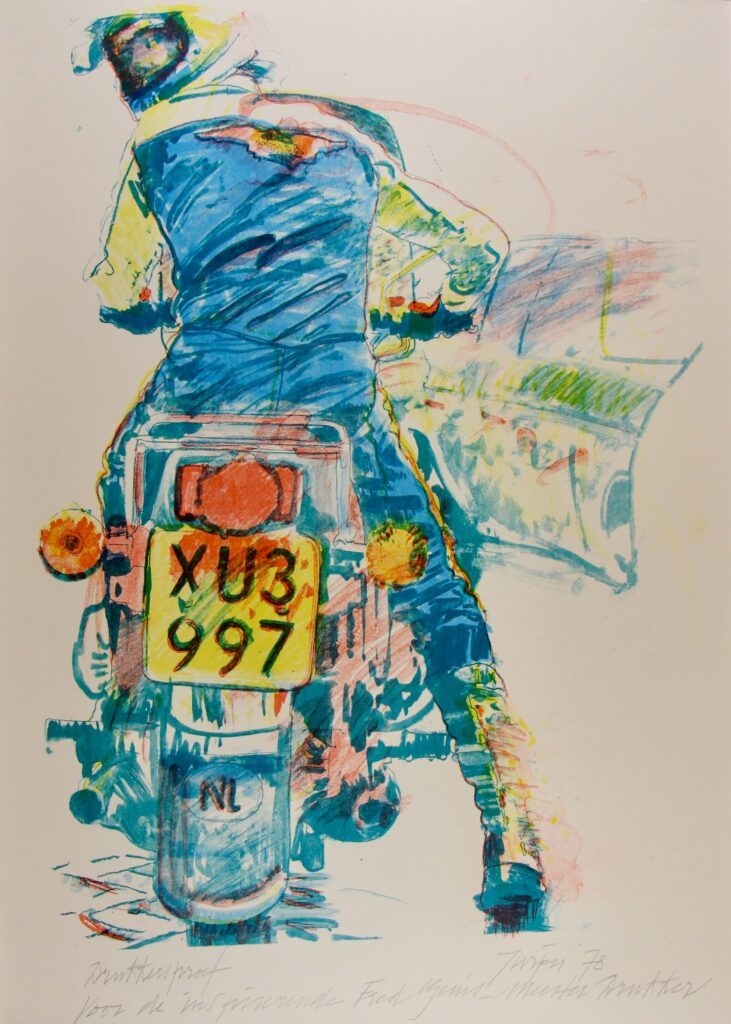
Jurjen de Haan was born in the Netherlands in 1936. A painter and draughtsman who worked in close creative and personal partnership with Maarten van Dreven, the two were central figures in a circle of Dutch artists who found their way to Fred Genis’s workshop at Oudkerk in Friesland during the 1970s. Like Van Dreven, de Haan preferred working in large format, and the two shared a sensibility rooted in close, frank observation of the human body and its relationship to the physical world.
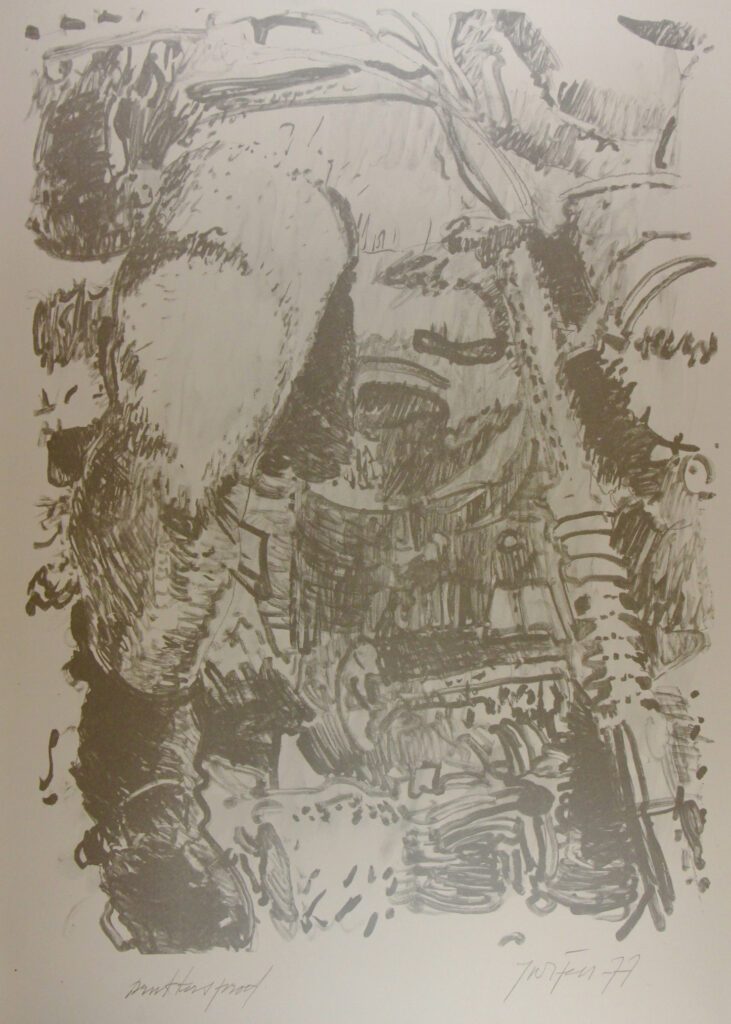
Where Van Dreven’s work gravitates toward clothing and fetish objects, de Haan’s prints reveal a quieter, more contemplative preoccupation — the figure in motion, the human relationship with machines, the particular poetry of everyday movement. His prints produced with Fred Genis at Oudkerk — Walking with Bike, On Bike, and Black and White Close Up Engine — take the bicycle as their central subject, rendered with the same large-format precision and patient attention that characterises the best work to come out of that workshop. The bicycle, an object so deeply embedded in Dutch daily life as to be almost invisible, becomes in de Haan’s hands something worth looking at slowly and seriously — a machine of elegant simplicity, and a vehicle for the most ordinary kind of human freedom.
The close-up engine study demonstrates a more abstract sensibility — mechanical form stripped of context and examined purely as shape, texture, and line.
Jurjen de Haan died in 2018. His work is held in the Rijksmuseum collection in Amsterdam, where a double portrait of de Haan and Van Dreven also resides — a quiet monument to a life and a practice shared.