Robert Morris was born in Kansas City, Missouri, in 1931. One of the most intellectually restless and formally adventurous artists of the postwar era, Morris was a central figure in the development of Minimalism in the 1960s before moving decisively beyond it — into Process Art, Land Art, installation, and politically charged conceptual work. Few artists of his generation ranged as widely or questioned as persistently the nature of art objects, the role of the viewer, and the relationship between art and power.
Morris studied at the Kansas City Art Institute, the California School of Arts and Crafts, and Reed College, before completing a Master of Arts at Hunter College in New York. His early Minimalist sculptures — simple geometric forms in industrial materials — were among the defining works of that movement, insisting on the viewer’s physical presence and perception as essential to the work’s meaning. But Morris was never content to remain within any single position, and his subsequent practice expanded to encompass felt scatter pieces, earthworks, and installations of increasing psychological and political complexity.
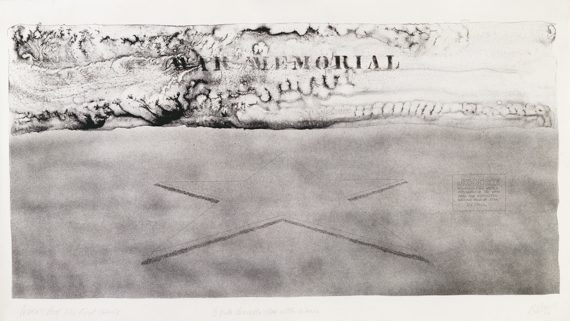
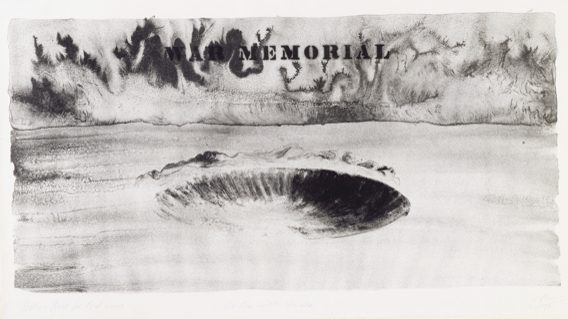
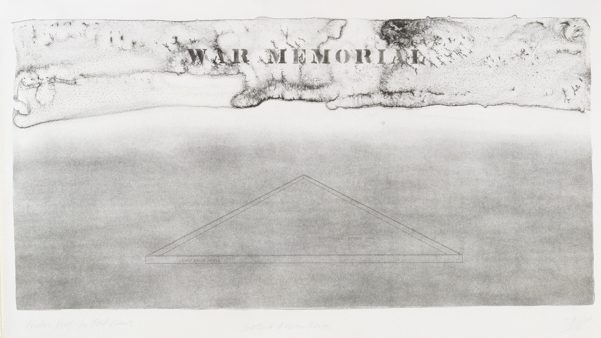
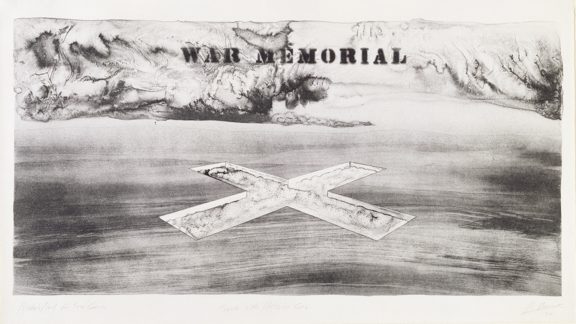
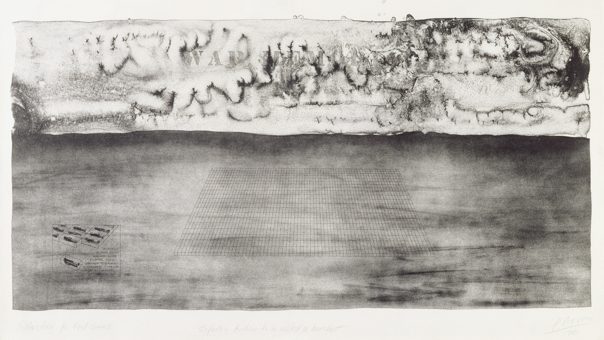
His Five War Memorials series was produced at Hollanders Workshop, New York, in collaboration with Fred Genis and Irwin Hollander. Each work in the series takes as its subject a different form of organised human destruction — a concrete star bearing the names of the fallen, a crater trailing smoke, scattered atomic waste, a trench filled with chlorine gas, and an infantry archive intended to be walked on barefoot. The series does not memorialise war so much as indict it, confronting the viewer with the physical and moral weight of collective violence in ways that are unflinching and deeply affecting. That such a series was realised through the intimate, craft-based medium of lithography only deepens its impact.
Robert Morris died in Kingston, New York, in 2018.